

24/7 claims support
Submit a home insurance claim in minutes through the belairdirect mobile app or online. Then, track your claim until it’s been resolved.
Your insurance is in your hands. Switch your home insurance to belairdirect today and enjoy great deals!
Perhaps you've been saving up to buy your dream condo in Montreal. Or maybe you're planning to start a family and are looking to purchase a house in Laval. In any case, your home is one of your most valuable possessions and deserves the best protection.
At belairdirect, we recognize that a home is more than just a place to live, and we want to ensure you're fully protected.
More than 18,800 reviews on Google with a rating of 4.4 out of 5.
Pays to repair or rebuild your home if it's damaged or destroyed, including its attached and outdoor structures, like a garage, porch, fence, carport, etc.
It covers:
Not covered:
Pays to repair or rebuild damaged or destroyed structures on your property not physically connected to your home, like a detached garage, storage shed, etc.
It covers:
Not covered:
Pays to repair or replace damaged or stolen furniture, clothing, electronics, appliances, or any other item usually located in your home.
It covers:
Also included: Replacement costs
Certain items are only covered up to a limited amount detailed in your insurance policy, like jewelry, cannabis, money, bikes, etc.
Not covered:
Pays for the increase of certain living expenses when you're unable to stay in your home during repairs when it's too damaged to live in.
Reimburses you for the excess costs of living elsewhere during a claim for the following:
Not covered:
Covers your defence costs and any damages or losses (indemnity) when you're legally obligated to pay for accidentally injuring someone or unintentionally damaging their property.
It covers:
Not covered:
Pays to repair your home and personal belongings after accidental water damage, like a burst pipe, overflowing sink, etc.
It covers:
Water damage to your home is covered unless otherwise excluded in your insurance policy.
Not covered:
Pays to repair damage to your home and personal belongings from a backed-up sewer, excessive rain, snow or melting snow that leaks into your home.
It covers:
Sump pump
A sump pump is a device installed in your basement or crawl space that helps prevent water damage and flooding. It evacuates excess water from your foundation and the water table around your home towards the municipal water system or the outside drainage area.
Not covered:
Pays to repair damage to your home and personal belongings from a flood, backed-up sewer, rain, snow or melting snow that leaks into your home.
It covers:
Sump pump
A sump pump is a device installed in your basement or crawl space that helps prevent water damage and flooding. It evacuates excess water from your foundation and the water table around your home towards the municipal water system or the outside drainage area.
Not covered:
Pays to repair water damage to your home and personal belongings caused by rain, melting snow or ice.
It covers:
Not covered:
Covers the cost to remove and repair a damaged private water service pipe connected to your home from the city water main.
It covers up to a maximum of $10,000 in repairs:
Water service line connected to your home
The water service pipe connects to your private water service line to carry clean water from the municipal water system into your home.
Not covered:
Covers certain fees and expenses to help restore your identity if it gets stolen.
It covers:
Not covered:
Pays for damage to your home and personal belongings caused by an earthquake.
It covers:
Not covered:
Pays for damage to your home and personal belongings caused by fire, smoke or an explosion after an earthquake.
It covers:
Not covered:
Prevents your price from increasing because of your first home insurance claim. Learn more about home claim forgiveness.
It covers:
Not covered:
The price of your home insurance will automatically adjust at each renewal to keep up with rising costs (among other things, inflation).
Protects your home if you rent it to guests for more than 30 days a year.
It covers:
Not covered:
Buying home insurance online has never been easier with belairdirect! Complete your quote online and get up to 10% discount.
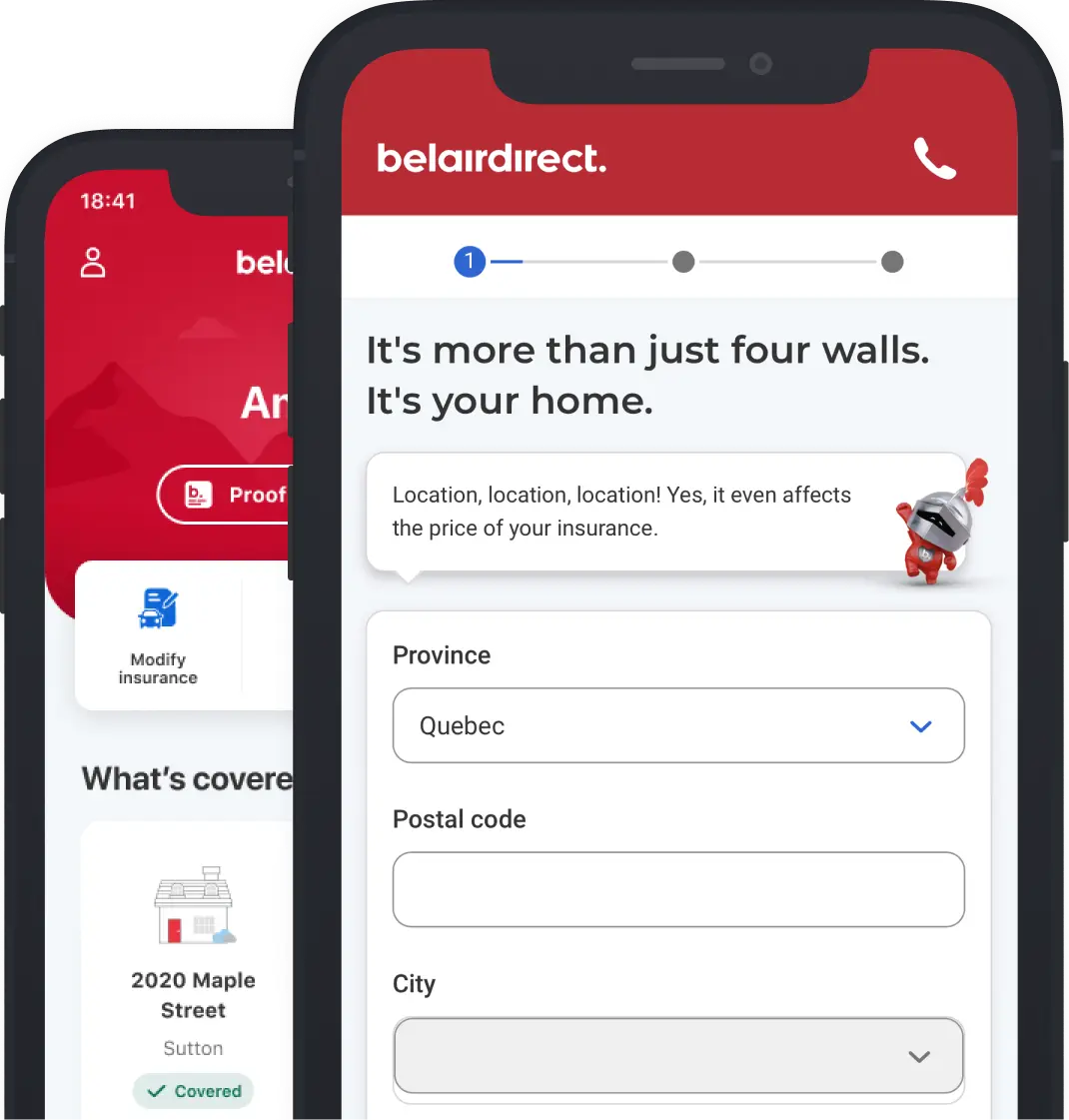
Get instant access to your home insurance wherever you are. Managing your home insurance policy and submitting a claim has never been this quick and easy!
In Quebec, home insurance is not required by law, which is also the case for the rest of Canada. However, when you apply for a mortgage, the bank will require you to apply for insurance in order to approve you for the loan. A house is probably going to be the biggest investment you’ll ever make. Over time, it’s value will increase. Losing your home to a fire or a natural disaster like the Rivière des Prairies flooding could set you back financially by a few years. Although home insurance is legally optional, any financial professional will tell you it’s just good sense to protect yourself and your biggest investment.
Although home insurance covers everything within your home in the event of theft or damage, high value items such as your collection of signed Expos baseball cards might require a separate, specific policy. Your policy may protect these items for certain damages but may not cover them in all circumstances or for the full amount. What if you lose your wedding ring while doing the dishes? It would be covered if it were damaged by fire or stolen, but this situation doesn’t fall under either of those categories. When in doubt, always consult your policy to ensure your valuables are covered. Consider taking out a separate policy to properly protect these specific items.
3 major aspects are covered by home insurance.
The first thing that is covered by your home insurance is the house itself. Consider the value at which you are insuring your home. You can either insure the house for the value that you paid for it or what it will cost to rebuild it in the event of a total loss. If you bought an older home in Westmount and you have to rebuild it after a fire, the costs may be higher since there will be new construction regulations in place and you would need to meet such regulations, which add up in the rebuild costs.
The second thing covered by home insurance are your belongings and the contents of the home. Things such as your furniture, your clothing and anything within the confines of the house. Possessions are covered in the event that they are damaged, stolen or have perished from a covered incident.
The third facet is your personal liability (or TPL). If ever an accident were to occur on your property, as the homeowner you would be held responsible. Between any medical expenses and the possible loss of income, the costs could financially ruin somebody. Personal liability coverage will ensure that you’re protected if ever an accident occurs on your property.
In 2017, the Ottawa River overflowed and 5,371 homes were flooded. People in the Gatineau region were evacuated from their homes and many lost their cherished possessions, including their houses. Many Quebecers have since asked themselves the same question: “Am I covered in the event of a flood?”
The answer may surprise you. A recent survey found that 69% of Quebecers believe their current home insurance policy covers them in the event of flooding. Although water damage is covered in standard home insurance policy, water damage is defined as damage caused by an internal water source (leaky pipes, bad plumbing, forgetting to turn off a faucet, etc.,)
External sources, such as a sewage backup or rising flood waters would not be covered by such an endorsement. By adding flood coverage, you stand to remain protected no matter what happens and you’ll have peace of mind that you’ll receive the proper reimbursement for the damages caused to your home. Talk to your insurance agent or broker about flood insurance if you think you live in an area near a body of water that poses a risk.
The Insurance Bureau of Canada has identified Quebec and British Columbia as the two major earthquake zones in Canada. Interestingly, less than 5% of homeowners with insurance in Quebec decide to purchase this coverage whereas in BC, 60% of insured residential homes are covered. Although major damages have yet to be experienced on the East Coast, you should talk to your insurer to see what risks are posed and if there’s a reasonable price you can find to cover yourself in the event of such a natural disaster.
When you think of Quebec , tornadoes and hurricanes don’t often come to mind. Although hurricanes have rarely made landfall in the province, mostly causing havoc in the Maritimes, tornadoes are an often overlooked risk.
In 2018 alone, there were no less than 6 tornadoes that struck the Gatineau region. Hundreds of people were left without power and over 60 buildings were damaged in the aftermath.
Although damages caused by a tornado (and all windstorms) are usually covered within a standard home insurance policy, it is important to review your policy and ensure what is protected by windstorm coverage and associated risks.
Talk to your agent or broker if you have questions about your current policy and take steps to limit damage in the event of a tornado such as storing away patio furniture that could be turned into a projectile once wind speeds pick up.