

24/7 claims support
Submit a home insurance claim in minutes through the belairdirect mobile app or online. Then, track your claim until it’s been resolved.
It pays to switch your home insurance to belairdirect!
No matter if you've invested in a property in Vancouver, you want to start a family in Prince Rupert, or you’re considering moving into strata housing, your home deserves proper protection. Here at belairdirect, we understand that a house is more than just bricks and mortar or an investment in your portfolio…
It's where you raise your children and create memories for life. We want to make sure you’re protected from all insured perils.
More than 18,800 reviews on Google with a rating of 4.4 out of 5.
Pays to repair or rebuild your home if it's damaged or destroyed, including its attached and outdoor structures, like a garage, porch, fence, carport, etc.
It covers:
Not covered:
Pays to repair or rebuild damaged or destroyed structures on your property not physically connected to your home, like a detached garage, storage shed, etc.
It covers:
Not covered:
Pays to repair or replace damaged or stolen furniture, clothing, electronics, appliances, or any other item usually located in your home.
It covers:
Also included: Replacement costs
Certain items are only covered up to a limited amount detailed in your insurance policy, like jewelry, cannabis, money, bikes, etc. Further details are listed in your home insurance policy.
Not covered:
Pays for the increase of certain living expenses when you're unable to stay in your home during repairs when it's too damaged to live in.
Reimburses you for the excess costs of living elsewhere during a claim for the following:
Not covered:
Covers your defence costs and any damages or losses (indemnity) when you're legally obligated to pay for accidentally injuring someone or unintentionally damaging their property.
It covers:
Not covered:
Pays to repair your home and personal belongings after accidental water damage, like a burst pipe, overflowing sink, etc.
It covers:
Water damage to your home is covered unless otherwise excluded in your insurance policy.
Not covered:
Between your municipality’s aging infrastructure and increasingly extreme weather conditions, water damage has become a growing concern for homeowners everywhere. Protect yourself from cleanup expenses and repairs caused by water damage with the optional Enhanced Water Damage Package.
Pays to repair water damage to your home and personal belongings caused by a backed-up sewer or septic system.
It covers:
Sump pump
A sump pump is a device installed in your basement or crawl space that helps prevent water damage and flooding. It evacuates excess water from your foundation and the water table around your home towards the municipal water system or the outside drainage area.
Not covered:
Pays to repair or replace broken exterior sewer or water service lines on your property.
It covers up to a maximum of $10,000 in repairs and damage:
Water and sewer lines connected to your home
The water service pipe connects to your private water service line to carry clean water from the municipal water system into your home. The sewer pipe drains wastewater from your indoor plumbing, including sinks, clothes or dish washers, and bathrooms.
Not covered:
Pays to repair damage to your home and personal belongings caused by a flood.
It covers:
Damage to your home and personal belongings caused by:
Not covered:
Pays to repair damage to your home and personal belongings caused by water entering your home through basement walls, floors or the foundation.
It covers:
Not covered:
Pays to repair damage to your home and personal belongings caused by severe winds.
It covers:
Further details are listed in your home insurance policy.
Pays to repair damage to your home and personal belongings caused by a hailstorm.
It covers:
Further details are listed in your home insurance policy.
Covers certain fees and expenses to help restore your identity if it gets stolen.
It covers:
Not covered:
It covers:
Not covered:
Prevents your price from increasing because of your first home insurance claim. Learn more about home claim forgiveness.
It covers:
Not covered:
The price of your home insurance will automatically adjust at each renewal to keep up with rising costs (among other things, inflation).
Protects your home if you rent it to guests for more than 30 days a year.
It covers:
Not covered:
Buying home insurance online has never been easier with belairdirect! Complete your quote online and get up to 10% discount.
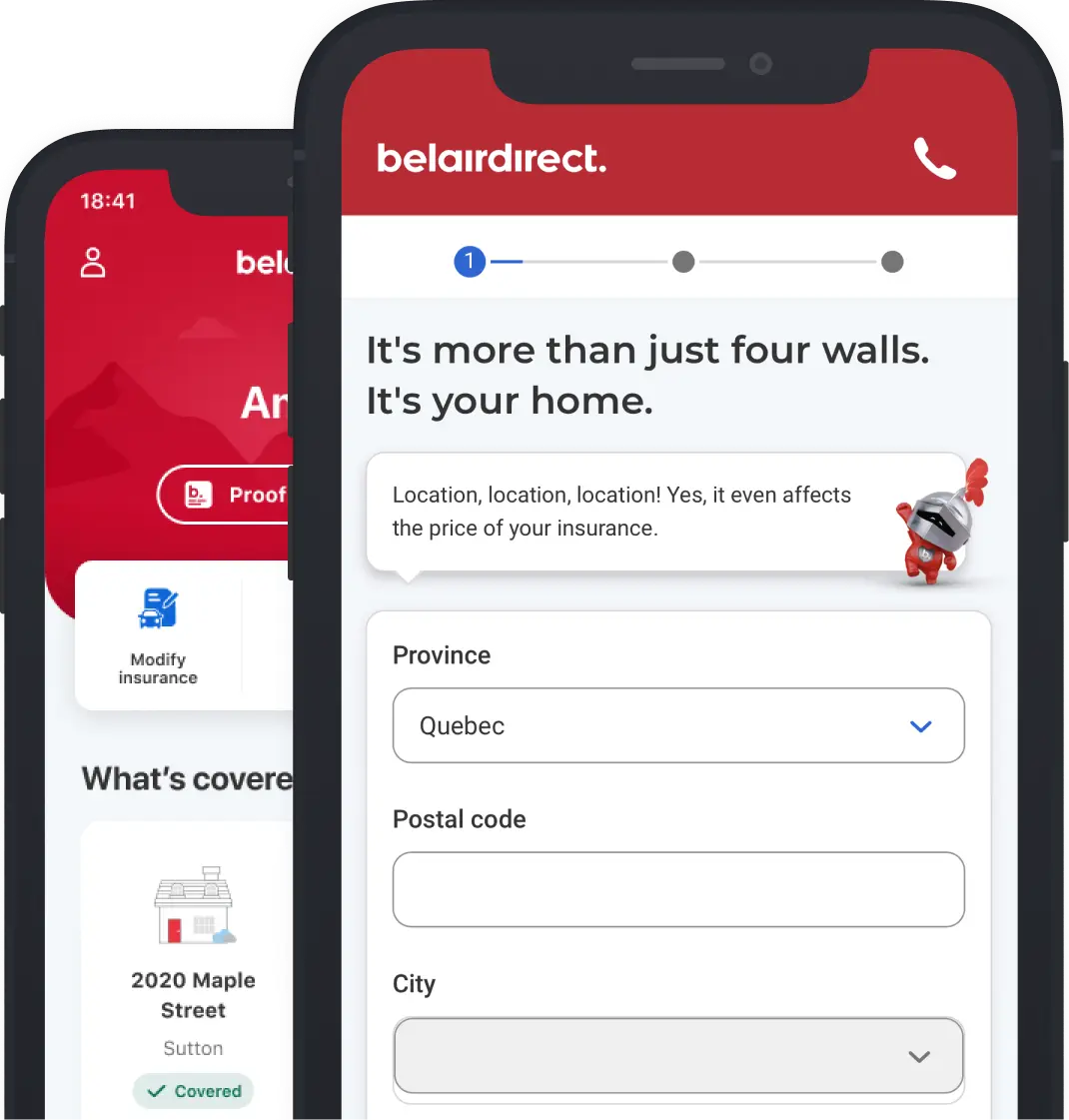
Get instant access to your home insurance wherever you are. Managing your home insurance policy and submitting a claim has never been this quick and easy!
British Columbia, much like the rest of Canada, does not legally require a person to purchase home insurance. The catch is most banks and lenders require you to obtain a basic policy in order to approve you for a mortgage. So unless you plan on paying for your home all at once, there’s no getting out of it.
Even if you could pay for your home without a loan, home insurance is a smart investment because your home is an investment. A big one at that. If ever something were to happen such as a fire or a natural disaster, it could set you back years and potentially ruin you financially. What if an accident occurs on your property? You could be held liable as the homeowner.
Why take the risk? At belairdirect, we’ll help you find the coverage options that will protect both you and your home at the lowest rate possible.
3 major facets are protected within a home insurance policy.
The first is the house’s structure. When insuring your home, remember that what you paid for your house may not be the value required to rebuild it in the event of a loss. An older home in Nanaimo may require newer materials to rebuild it from scratch, which can cost you much more. This is the value you should consider insuring the building for.
The second facet is covered in a home insurance policy are the contents of the home. Your possessions such as your furniture, your collection of Lululemon tights, your yoga mats and the rest of the items within your home. Your policy will cover you in the event that your items are damaged, stolen or lost due do a covered incident.
Note that high-value items may not be covered under all circumstances. Priceless art, jewelry and other items of value may require a separate policy. Your one-of-a-kind piece of Kaska Dena art may be covered in a fire, but it might not if it gets lost while moving.
The final facet is your personal liability. When an accident occurs on your property, you can be held responsible as the homeowner. Home insurance can cover any costs related to the accident so that your guests remain covered without bankrupting you.
It seems the biggest worry on the West Coast is the “big one” and when it will hit. Jokes aside, British Columbia does sit within the large earthquake zone that covers the western coast of the continent. Although the “big one” may not occur within our lifetimes, smaller earthquakes can still cause damage to your home and leave you with thousands of dollars of repairs and ruined property. Only about 50% of BC residents have some form of earthquake insurance included in their policy. Some insurance companies have even begun including earthquakes as a mandatory risk because of their prevalence.
As for damages caused by a tsunami, there currently is no specific coverage to protect your home and possessions. Earthquake insurance does not cover water damage. Therefore, it is recommended you include flood insurance if you live near the coast. Talk to your insurance broker for advice and to see what coverage options are best for your specific situation.
With pristine landscapes, rocky coastlines and acres of forest to discover, many are tempted to explore BC’s natural beauty with an RV or mobile home. When travelling and living in mobile home for longer periods of time, there are several things to consider when insuring it.
An RV is a vehicle, so naturally it will require the minimum coverage needed for any vehicle such as third-party liability coverage, accident benefits and hit-and-run coverage. However, because you use the vehicle as a home and store various valuable possessions in it, you’ll need extra protection in the event your property gets damaged or stolen.
Furthermore, what happens if someone injures themselves inside your RV while you’re parked somewhere in Kootenay National Park? Are you still covered if you leave BC to visit Banff for a few days? Talk with you insurance agent to see what your best coverage options are based on how you plan to use your RV while you travel.
With memories of the damage caused by rampant wildfires fresh in everyone’s mind, many BC residents are anxious to know if they need specific coverage to insure their houses from such a natural disaster. The good news is that fire is a covered damage in most home insurance policies (although you should always check, just in case).
The bad news is that if your property is located within a known wildfire zone, you may be subject to higher premiums or even denied coverage in some extreme cases. Talk to your insurer or broker before purchasing a property you believe to be at risk and see what they can offer you in terms of protection.