

24/7 claims support
Submit a home insurance claim in minutes through the belairdirect mobile app or online. Then, track your claim until it’s been resolved.
It pays to switch your home insurance to belairdirect!
No matter if you’ve been putting away money to buy yourself a dream home in Roxboro, Calgary or you just want to start a family in a cozy bungalow in Strathcona, Edmonton, your home is most likely your largest investment and we want to help you protect it.
At belairdirect, we understand that your house is more than just a roof over your head... It's your sanctuary and we want to ensure you're protected.
More than 18,800 reviews on Google with a rating of 4.4 out of 5.
Pays to repair or rebuild your home if it's damaged or destroyed, including its attached and outdoor structures, like a garage, porch, fence, carport, etc.
It covers:
Not covered:
Pays to repair or rebuild damaged or destroyed structures on your property not physically connected to your home, like a detached garage, storage shed, etc.
It covers:
Not covered:
Pays to repair or replace damaged or stolen furniture, clothing, electronics, appliances, or any other item usually located in your home.
It covers:
Also included: Replacement costs
Certain items are only covered up to a limited amount detailed in your insurance policy, like jewelry, cannabis, money, bikes, etc. Further details are listed in your home insurance policy.
Not covered:
Pays for the increase of certain living expenses when you're unable to stay in your home during repairs when it's too damaged to live in.
Reimburses you for the excess costs of living elsewhere during a claim for the following:
Not covered:
Covers your defence costs and any damages or losses (indemnity) when you're legally obligated to pay for accidentally injuring someone or unintentionally damaging their property.
It covers:
Not covered:
Pays to repair your home and personal belongings after accidental water damage, like a burst pipe, overflowing sink, etc.
It covers:
Water damage to your home is covered unless otherwise excluded in your insurance policy.
Not covered:
Between your municipality’s aging infrastructure and increasingly extreme weather conditions, water damage has become a growing concern for homeowners everywhere. Protect yourself from cleanup expenses and repairs caused by water damage with the optional Enhanced Water Damage Package.
Pays to repair water damage to your home and personal belongings caused by a backed-up sewer or septic system.
It covers:
Sump pump
A sump pump is a device installed in your basement or crawl space that helps prevent water damage and flooding. It evacuates excess water from your foundation and the water table around your home towards the municipal water system or the outside drainage area.
Sump pump failures may be avoided by installing a back up power system.
Not covered:
Included in the Enhanced Water Damage Package for Homeowners
Pays to repair or replace broken exterior sewer or water service lines on your property.
It covers up to a maximum of $20,000 in repairs and damage:
Water and sewer lines connected to your home
The water service pipe connects to your private water service line to carry clean water from the municipal water system into your home. The sewer pipe drains wastewater from your indoor plumbing, including sinks, clothes or dish washers, and bathrooms.
Not covered:
Included in the Enhanced Water Damage Package for eligible risks.
Pays to repair damage to your home and personal belongings caused by a flood.
It covers:
Damage to your home and personal belongings caused by:
Not covered:
Included in the Enhanced Water Damage Package for eligible risks.
Pays to repair damage to your home and personal belongings caused by water entering your home through basement walls, floors or the foundation.
It covers:
Not covered:
Pays to repair water damage to your home and personal belongings caused by severe winds or a hailstorm.
It covers water damage caused by:
Pays to repair damage to your home and personal belongings caused by severe winds.
It covers:
Further details are listed in your home insurance policy.
Pays to repair water damage to your home and personal belongings caused by severe winds or a hailstorm.
It covers water damage caused by:
Covers certain fees and expenses to help restore your identity if it gets stolen.
It covers:
Not covered:
Pays for damage to your home and personal belongings caused by an earthquake.
It covers:
Not covered:
Prevents your price from increasing because of your first home insurance claim. Learn more about home claim forgiveness.
It covers:
Not covered:
The price of your home insurance will automatically adjust at each renewal to keep up with rising costs (among other things, inflation).
Protects your home if you rent it to guests for more than 30 days a year.
It covers:
Not covered:
Buying home insurance online has never been easier with belairdirect! Complete your quote online and get up to 10% discount.
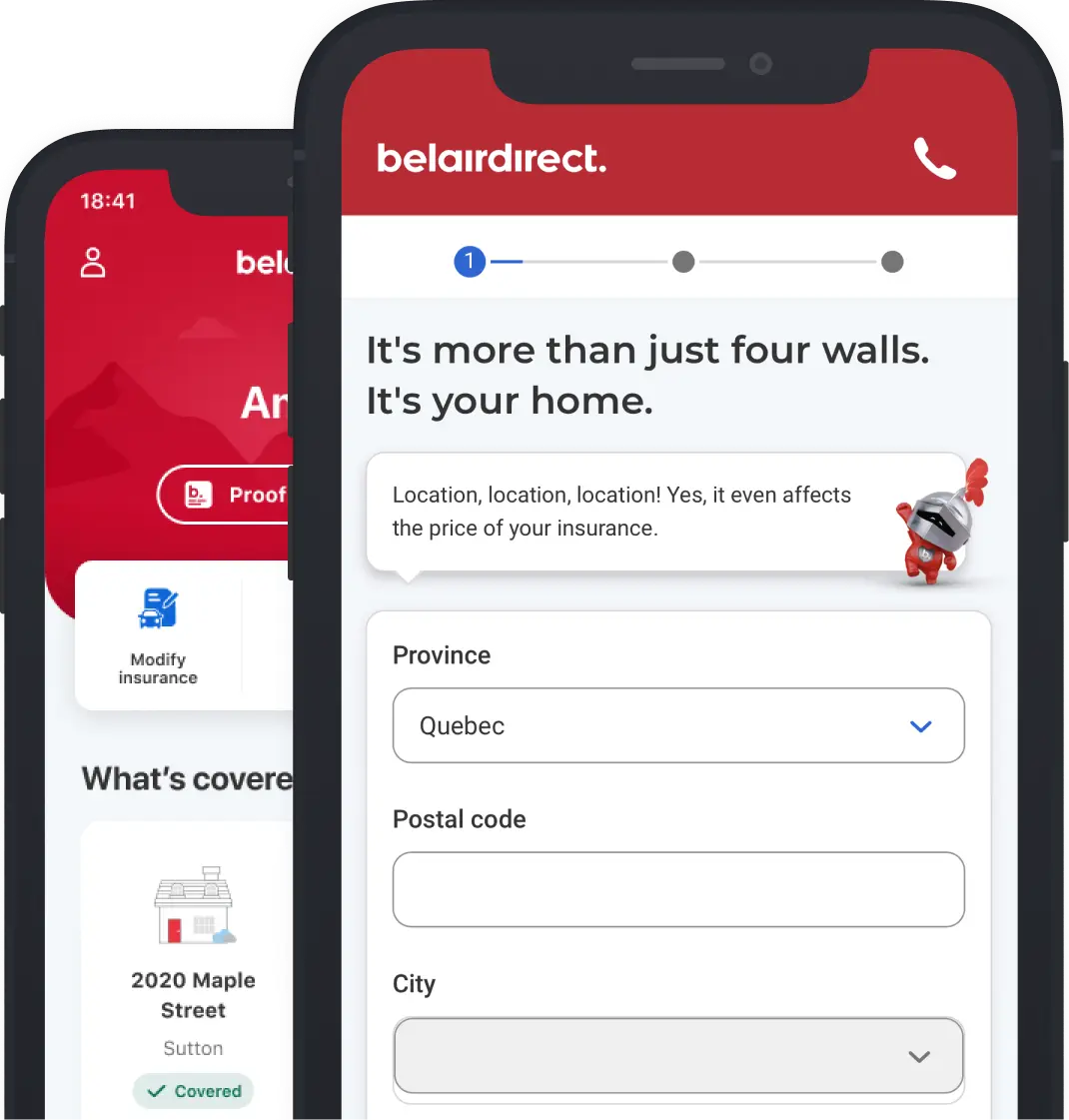
Get instant access to your home insurance wherever you are. Managing your home insurance policy and submitting a claim has never been this quick and easy!
The short answer: No. At least not technically. Much like the rest of Canada, there’s no legal requirement for you to insure your home, unlike car insurance.
That being said, your lender will more than likely going to require you to apply for home insurance in order to approve you for a mortgage. So unless you plan on buying your house with cash in hand, home insurance is something you’ll need to look into. It should be seen as a way of protecting one of the biggest investments you’ll ever make and ensure that you won’t be set back financially should anything ever happen.
A home insurance policy covers three facets.
Arguably, the most important is your personal liability. If ever an accident were to occur on your property and someone got injured or killed, your home insurance would cover you for any medical bills and expenses that may stem from the incident. Consider home insurance not only as something to protect yourself, but as a method of ensuring your guests are cared for if ever they got hurt on your property.
The second is the structure itself. When you put your hard-earned money towards something this large, it’s nice to know you won’t have to worry about losing your investment to a natural disaster, such as a forest fire or any other unforeseen risks. When buying home insurance coverage, consider the scenario of a total loss where you have to rebuild the house from the ground up. If the structure is older and requires newer materials to be up-to-code, you may want to insure it for the cost it would require to rebuild it. Talk to your insurance agent or broker to see what your best coverage options are.
The third is the contents of your home. Your furniture, your wardrobe, your appliances, and whatever’s under your roof and within your four walls. Generally speaking, if it’s within your home and it gets damaged by a covered incident, it falls under the scope of your home insurance policy. Higher value items, however, may require a separate policy.
Your home contains a lifetime’s worth of physical objects. Having to start from scratch is something nobody should have to endure.
Certain high value items, such as jewelry, art and any objects of value require a separate policy. Your policy protects you from covered risks such as a home invasion or an electrical fire. But what if your handcrafted saddle you got from the Calgary Stampede gets lost while moving? This is not a covered risk. Consult your policy to ensure your valuables are protected and talk to your insurance broker or agent. Consider taking out a separate specific policy to properly protect them.
With the memories of the Fort McMurray fires and the destruction they brought still fresh in people’s minds, many Albertans wonder if their homes are covered if such an event were to happen to them. In view of the fact that fire coverage is a covered risk in a basic home insurance policy, the short answer is yes.
This however, will not apply to other natural disasters such as floods or earthquakes, which have separate coverage policies. When purchasing and applying for insurance on your home, if you are located within a zone designated as at-risk for wildfires, such as Parsons Creek or Beacon Hill, your premiums may increase because of it.
It’s important to discuss these risks with your insurance agent before agreeing on a home insurance policy.
First things first, if you are selling your home do not cancel your current home insurance until you have heard that the deal has closed. If you’re moving out from the house and suspect it will remain unoccupied for longer than 30 days, contact your insurance company to give them a heads up that the property will be vacant. This ensures that you remain covered until the property is claimed by the new owners and avoid any unnecessary risks.
If you just bought your house, make sure you have your mortgage and home insurance in place well in advance of closing day, as your insurer will want to inspect the new home themselves to give you a quote on a rate. This protects both you and the lender in the event that there’s a fire or any risk that leads to the loss of the house before you even take possession of it.